
Inside Bran Castle
A Complete Room-by-Room Guide
Bran Castle has 57 rooms spread across four floors, including the Great Hall, Queen Marie’s Royal Apartments, King Ferdinand’s Suite, the Armory, a Torture Museum, and the famed Secret Passage. The visit follows a set route through the castle’s interior, courtyard, and the underground Time Tunnel. Allow 1.5 to 2 hours for a comfortable self-guided tour.
Standing on a rocky cliff at the border of Transylvania and Wallachia, Bran Castle is one of the most dramatic and storied buildings in all of Europe. Known worldwide as Dracula’s Castle, it draws over half a million visitors each year — and for good reason. Step inside and the castle reveals itself as far more than a gothic backdrop: it is a layered world of medieval fortification, royal elegance, royal tragedy, and vampire legend.
This complete room-by-room guide walks you through everything you’ll encounter on your visit — from the sweeping Great Hall to the narrow secret staircase hidden behind a stove, and from Queen Marie’s silk-draped salon to the subterranean Time Tunnel. Whether you’re planning your first visit or trying to make the most of every room, this is the guide to bookmark.
Bran Castle Interior: What to Expect
The interior of Bran Castle is a maze of 57 rooms across four floors, connected by steep wooden staircases and winding stone corridors. Rooms showcase royal furniture, medieval weapons, hand-carved woodwork, and portraits from Romania’s royal family. Photography is allowed without flash. The visit takes a set one-way route, typically lasting 1.5 to 2 hours.
The interior of Bran Castle is best described as a beautiful maze. Unlike many European castles that follow a grand linear plan, Bran’s rooms twist and turn through its irregular hilltop footprint, connected by steep wooden staircases, narrow doorways, and unexpected balconies that open onto the courtyard below.
Visitors follow a guided one-way route through the castle’s four floors, meaning you cannot backtrack easily. Each room is clearly labeled with multilingual interpretation panels, and the castle’s museum quality is genuinely high — the royal furniture is original, the weapons are authentic, and the architectural details reward a slow pace.
Photography is permitted throughout for personal use, but flash photography and tripods are prohibited to protect the historic interiors. Large bags must be left at the entrance or stored before you go in.
The Ground Floor: Gateway to the Castle
The visitor journey begins at the main entrance, a stone gateway that leads to the base of the castle. The ground floor contains some of the castle’s oldest surviving elements, including two iron doors dating to 1693 — among the oldest documented fixtures inside the building. These doors, heavy and darkened with age, set the tone immediately.
The ground floor also contains the Gothic Room, notable for its dark carved wood furniture and its distinctly pre-royal atmosphere. The narrow, steep stairway that leads to the upper floors begins here, and it is worth pausing to appreciate the original stone and timber construction that surrounds you.
First Floor: The Great Hall and the Armory
The first floor is where Bran Castle’s medieval character is most powerfully felt. The Great Hall — the castle’s largest single room — dominates this level. Its wooden ceiling beams, massive stone fireplace, and decorative tapestries evoke the medieval gatherings that would have taken place here: feasts, assemblies, and strategic councils in the centuries before Queen Marie’s era.
Adjacent to the Great Hall, the Armory presents an impressive collection of medieval weaponry: swords, shields, crossbows, suits of armor, and a range of tools that reflect the castle’s role as a strategic fortress against Ottoman expansion. The craftsmanship of the Transylvanian Saxon metalwork on display is a reminder that this region was a hub of skilled artisanship for nearly a thousand years.
Second Floor: Queen Marie’s Royal Apartments
If the first floor belongs to the medieval fortress, the second floor belongs to Queen Marie — and it shows. The Romanian queen, who received Bran Castle as a gift from the citizens of Brașov in 1920, transformed this ruined fortress into one of the most refined royal residences in Eastern Europe.
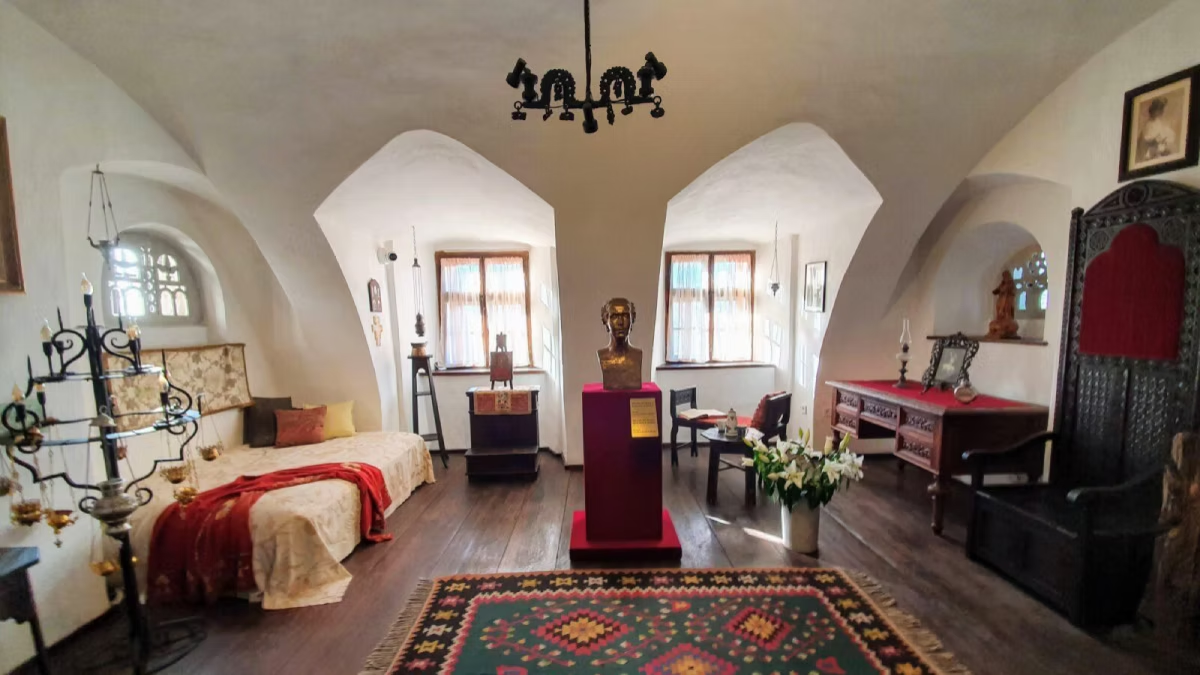
Queen Marie’s suite is the emotional heart of Bran Castle. Her rooms — a bedroom, a dressing room, two private salons, a dining area, and a bathroom — are furnished with extraordinary care. Ornate woodwork, hand-embroidered textiles, and personal portraits line the walls. The queen’s own artistic sensibility is visible in every corner, from the arrangement of ceramics on her mantelpiece to the view she chose to frame from her window.
This floor also contains the Dominic Collection, named after Archduke Dominic of Habsburg — the current owner of the castle — which includes fine glassware and decorative objects gathered across generations of the Habsburg family. A lounge area on this floor gives visitors a sense of how the castle functioned as a lived-in royal home rather than merely a museum.
The Secret Passage: Bran Castle’s Hidden Staircase
The secret passage at Bran Castle is a narrow hidden staircase concealed behind a stove in the council room on the first floor. Discovered in 1927, it connects the first and third floors directly, bypassing the second floor entirely. Historians believe it was built for emergency use or to allow discreet movement through the castle. It is one of the most photographed features inside Bran Castle.
One of the most talked-about features of the entire castle is its hidden staircase — a narrow passageway concealed behind a stove in the council room. Discovered in 1927, the passage connects the first and third floors directly, allowing someone to move between them without passing through the second floor.
The staircase is genuinely narrow; visitors pass through in single file. It is believed to have been built for emergency use or discreet movement through the castle, though its exact original purpose remains a subject of debate. Whatever its original function, it has become one of the castle’s most memorable moments — a reminder that Bran is full of surprises.
Third Floor: King Ferdinand’s Suite and the Dracula Room
The third floor houses King Ferdinand’s Suite, considered by many to be the best-preserved set of rooms in the entire castle. The king’s chambers are adorned with hand-carved fixtures on the walls and ceilings, ornate period furniture, and windows that look out over the village of Bran far below. The contrast with the grimmer lower floors is striking — this is a space built for comfort and prestige.
Also on the third floor is the Dracula Room — a small, deliberately modest space dedicated to Bram Stoker’s 1897 novel. The room contextualizes the Dracula legend: how it spread, why Bran became associated with it (primarily through the castle’s resemblance to Stoker’s description, despite the Irish author never having visited Romania), and what is historically documented about Vlad the Impaler’s actual connection to the site — which amounts to a probable two-month imprisonment here in 1462.
The room is intentionally honest in its storytelling: Bran is not, and does not claim to be, the “real” Dracula’s castle. But it leans into the legend with intelligence and good humor, making it one of the more thoughtful rooms in the building.
The Courtyard: The Heart of the Castle
At the center of Bran Castle lies its lush inner courtyard — a characteristic feature of medieval Transylvanian tower architecture. The courtyard is one of the most beautiful and photogenic spaces in the castle, surrounded on all sides by the building’s whitewashed walls, red-tiled roofs, and wooden balconies that overlook the space from every floor.
A stone well sits at the center of the courtyard. This well was later repurposed by Queen Marie — its shaft eventually became the elevator that leads to the Time Tunnel below. The courtyard also provides the clearest view of Bran Castle’s exterior architecture, and it is the spot where most visitors stop to photograph the castle in full.
The Time Tunnel: Bran’s Most Unexpected Experience
Few visitors expect what waits beneath Bran Castle. The Time Tunnel, accessed from Queen Marie’s former well shaft, begins with a glass elevator descending 31 meters into the bedrock. The first eight meters of the shaft expose the original 1937 rock tiles installed by Czech architect Karel Liman at Queen Marie’s request.
The tunnel itself is a multimedia experience that takes visitors through Bran Castle’s history — from its founding in 1377 to its royal era — via large-format imagery, lighting effects, and theatrical displays featuring a fire-breathing dragon, supernatural characters from Romanian folklore, a cloud of bats, and ghostly imagery. It concludes in the Royal Gardens below the castle.
The Time Tunnel costs an additional 30 lei (included in the Royal Tour combo ticket) and is genuinely worth it. It is the most unexpected and dramatically different part of the entire visit, and it works for visitors of all ages.
The Torture Museum: What You Need to Know
Adjacent to the main castle circuit, the Torture Museum is a separate, opt-in exhibit (additional ticket required: 30 lei, or included in the Royal Tour combo). It displays a collection of medieval instruments associated with the era of Vlad the Impaler and broader European torture practices.
The exhibit is presented in an educational context rather than a sensationalist one, but the content is genuinely disturbing and is not appropriate for young children. Visitors with children under 12 are advised to skip this section or allow older children to decide for themselves after understanding what it contains.
Visitor Tips for Exploring Inside Bran Castle
- Arrive at opening (9:00 AM Tuesday–Sunday) to avoid peak-hour crowds on the narrow staircases
- Wear closed-toe, non-slip shoes — the wooden stairs and stone floors can be slippery
- Photography without flash is allowed; no tripods
- No food or drinks permitted inside the rooms
- Large bags must be left at the entrance
- Allow 1.5 to 2 hours for the main castle tour; add 30 minutes for the Time Tunnel
- Book tickets in advance online to skip the queue at the main gate
Current Ticket Prices (2026)
Standard Tour: Adults 100 lei | Seniors (65+) 70 lei | Students 60 lei | Children (5–17) 40 lei | Under 5 free
Royal Tour with Priority Access (includes Torture Museum + Time Tunnel): Adults 170 lei | Children 110 lei
Add-ons: Time Tunnel 30 lei | Torture Museum 30 lei
Tickets are available online at the official Bran Castle website or at the ticket counter on arrival. Online booking is strongly recommended during summer and during October.
Frequently Asked Questions
How many rooms does Bran Castle have?
Bran Castle has 57 rooms across four floors, ranging from the grand Great Hall on the first floor to the intimate Dracula Room on the third floor.
Can you take photos inside Bran Castle?
Yes. Photography for personal use is permitted throughout the castle interior. Flash photography and tripods are not allowed, to protect the historic furnishings and interiors.
Is the visit to Bran Castle self-guided?
The standard visit is self-guided and follows a one-way route through the castle. Guided tours are available at a premium and must be booked in advance. Multilingual information panels are installed throughout every room.
Is Bran Castle wheelchair accessible?
The castle interior is not wheelchair accessible due to steep staircases, narrow corridors, and uneven floors — a structural reality of its Class A historical monument status. The exterior, grounds, and inner courtyard are accessible with staff assistance. A dedicated elevator leads to the inner courtyard. Disabled visitors receive free entry.
How long should I spend inside Bran Castle?
Plan for 1.5 to 2 hours for the main castle. If you add the Time Tunnel and the Torture Museum, budget 2.5 to 3 hours in total. The outdoor open-air village museum and the souvenir market below the castle can fill another 30–45 minutes.
