
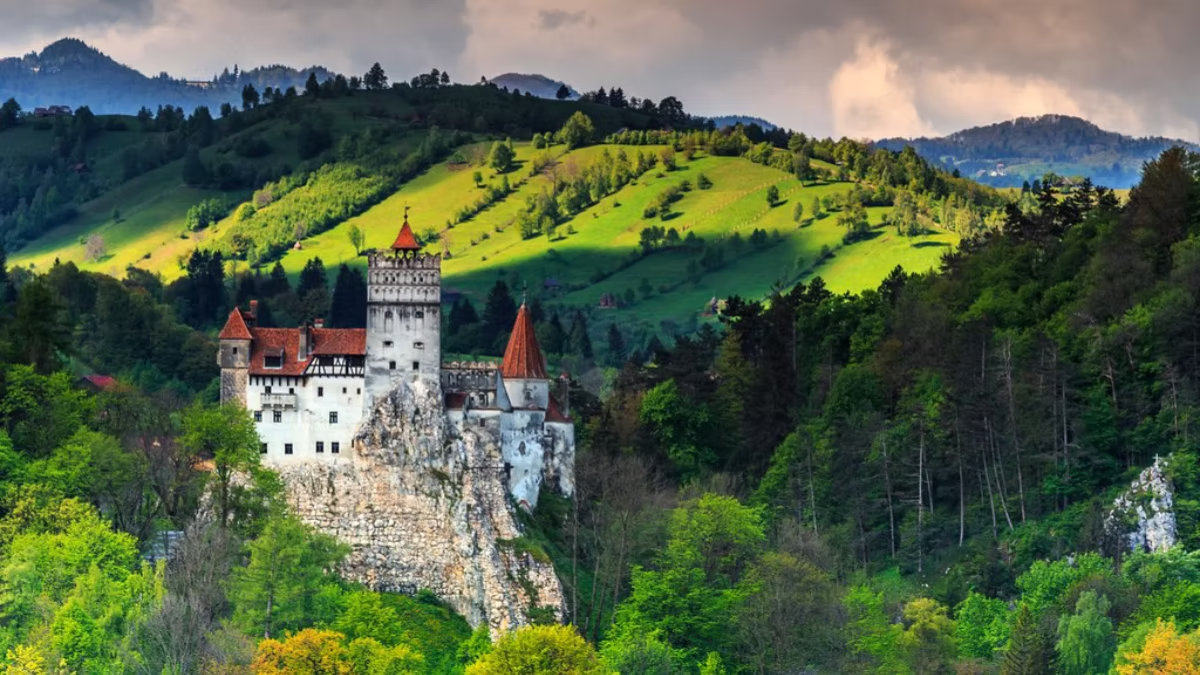
Bran Castle Facts
30 Things You Didn’t Know About Dracula’s Castle
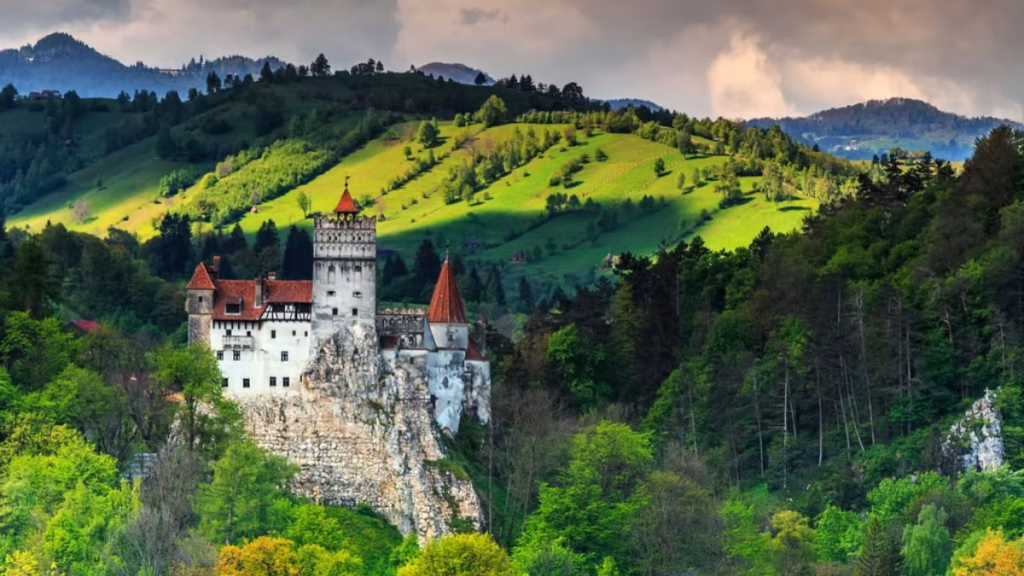
Bran Castle was built in 1377 by Transylvanian Saxons, has 57 rooms across four floors, and sits at 762 metres above sea level on the Transylvania-Wallachia border. It became a royal residence under Queen Marie in 1920, is now Romania’s first privately owned museum (since 2009), and attracts over half a million visitors per year. Bram Stoker never visited it, and Vlad the Impaler was most likely held prisoner there for two months, not a resident.
Bran Castle is one of the most visited buildings in Eastern Europe and the most famous castle in Romania — yet much of what most people think they know about it is either incomplete or outright myth. Here are 30 facts that give the full picture: the medieval history, the royal story, the Dracula legend, and the architectural details that make Bran Castle genuinely extraordinary.
Construction & Architecture
1. The stone castle was built in just over a decade
Construction of the current stone castle was authorised by King Louis I of Hungary on 19 November 1377 — the date of the first official written mention of the castle. It was completed by 1388, meaning the entire stone structure was built in approximately ten years by the Transylvanian Saxons of Brașov, who financed and built it themselves in exchange for trade privileges.
2. A wooden fortification existed on the site 165 years earlier
Before the stone castle, a wooden fortress called Dietrichstein was built on the same rocky outcrop in 1212 by knights of the Teutonic Order. It guarded the same mountain pass. The Mongol invasion of 1242 destroyed the wooden structure, leaving the site abandoned for over a century before the stone castle was commissioned.
3. Bran Castle sits at 762 metres above sea level
The castle is perched on a rocky cliff at 762 metres (2,500 feet) above sea level, on the border between Transylvania and Wallachia. This elevated position gave it commanding views over the Bran Gorge mountain pass below — the strategic trade and military route it was built to control.
4. The total site covers approximately 3,770 square metres
A comprehensive 3D scanning and architectural survey of Bran Castle, produced by Romanian architectural firm Xplorate Group, documented the castle’s total site area at approximately 3,770 square metres — including all interior spaces and exterior architectural elements.
5. The castle has 57 rooms across four floors
Bran Castle’s 57 rooms are distributed irregularly across four floors, following the contours of the rocky outcrop rather than any formal architectural plan. This gives the castle its characteristic maze-like quality — rooms connect through unexpected staircases and passages rather than in any predictable linear sequence.
6. The oldest surviving interior fixtures date to 1693
Two iron doors on the ground floor, among the oldest documented interior fixtures in the castle, date to 1693. They are among the most direct physical links to the castle’s pre-royal history that visitors can see today.
7. English mercenaries were stationed here in the 14th century
Historical records mention that brigades of English ballista men (crossbowmen) were among the mercenaries garrisoned at Bran Castle during the 14th century — an unusual footnote that reflects the castle’s role as a strategic fortification on a major European trade route.
Strategic History
8. The castle was built to stop Ottoman expansion
Bran Castle’s primary military purpose was to serve as a bulwark against the northward expansion of the Ottoman Empire into Transylvania. Between 1438 and 1442, the castle played an active role in the defence of the mountain pass against Ottoman raids. Its position at the Bran Gorge made it a critical chokepoint.
9. It also functioned as a customs post for centuries
In addition to its military role, Bran Castle served as an official customs post for goods crossing the Carpathian mountain pass between Transylvania and Wallachia for several centuries. Traders were required to pay duties on their goods here, making it both a fortress and a significant source of revenue for the region.
10. The castle withstood a siege by the Wallachian army in 1530
In 1530, Moise of Wallachia attempted to seize Bran Castle. Székely soldiers defending the stronghold successfully repelled the attack — one of several military engagements at the castle that are documented across its active centuries as a fortress.
11. It fell into disrepair for decades before Queen Marie
By the late 19th century, after the castle’s military and customs importance had waned, Bran fell into serious disrepair. When Queen Marie received the castle in 1920, it was described as being in a deplorable condition. Her decade-long restoration project transformed a ruined fortress into one of Eastern Europe’s finest royal residences.
The Royal Era
12. Queen Marie received the castle as a gift
In 1920, following the Treaty of Trianon that transferred Transylvania to Romania, the citizens of Brașov gifted Bran Castle to Queen Marie of Romania. She used it as her favourite summer residence until her death in 1938, investing extensive personal resources in its restoration and decoration.
13. Queen Marie was a granddaughter of Queen Victoria
Born Princess Marie of Edinburgh in 1875, Queen Marie was the granddaughter of both Queen Victoria of Britain and Tsar Alexander II of Russia. Her diplomatic work at the 1919 Paris Peace Conference — where she personally lobbied Allied leaders — is widely credited with securing Transylvania, Bessarabia, and Bukovina for Romania.
14. Queen Marie’s heart is buried at Bran Castle
At her request, Queen Marie’s heart was removed after her death in 1938 and placed in a golden casket to be buried at Bran Castle — her favourite residence. After decades of displacement during the communist era (including a period when the casket was lost and later found in the National History Museum), the heart was formally returned to Bran in 2015 and now rests in a memorial chapel on the southwest side of the castle grounds.
15. Princess Ileana turned the castle into a hospital during World War II
After inheriting the castle from her mother Queen Marie, Princess Ileana turned Bran into a hospital during World War II, nursing patients until the communist regime forced her out of Romania in 1948. The communists then opened the castle as a public museum in 1956.
16. The castle is now Romania’s first private museum
In 2009, the post-communist Romanian government returned the castle to Princess Ileana’s heirs — Archduke Dominic of Habsburg and his sisters. The family reopened it to the public, making Bran Castle Romania’s first privately owned museum. It has operated under this arrangement ever since.
The Dracula Connection
17. Bram Stoker never visited Bran Castle — or Romania
Bram Stoker, the Irish author of Dracula (1897), never visited Romania. He researched his novel from travel books and accounts in London. His fictional Castle Dracula is placed in a different part of Transylvania from Bran, though they share some visual similarities.
18. The Dracula-Bran connection was created largely by 1970s tourism
According to Bran Castle’s own official history, the link between the castle and the Dracula legend was established primarily by American tourists in the 1970s and 1980s, who associated the castle’s gothic silhouette and Transylvanian location with Stoker’s novel. The communist Romanian government promoted this association to drive tourism revenue.
19. Vlad the Impaler was probably imprisoned here — not a resident
The most credible historical connection between Vlad III (Vlad the Impaler) and Bran Castle is a probable two-month imprisonment in 1462, after he was captured by the Hungarian king Matthias Corvinus. He never owned or ruled the castle. His relationship to Bran is that of prisoner, not lord.
20. Bran is the only Transylvanian castle that matches Stoker’s description
Bran Castle’s official website notes that it is the only castle in Transylvania that matches the physical description in Stoker’s novel — a clifftop fortress commanding views over a mountain pass. This visual match is the strongest genuine link between the fictional castle and the real one.
Hidden Features & Unusual Details
21. The secret passage was discovered in 1927
The hidden staircase concealed behind a stove in the first-floor council room — now one of the castle’s most famous features — was discovered during Queen Marie’s restoration in 1927. It connects the first and third floors directly, bypassing the second floor. Its original purpose is debated; theories include emergency escape, discreet movement between floors, and strategic communication.
22. The “well” in the courtyard is actually an elevator shaft
The stone well visible in the inner courtyard is not a traditional water well. A 59-metre-deep well was dug in the 17th century, but in 1937, Czech architect Karel Liman repurposed the shaft into an elevator for Queen Marie, who by then found the castle’s steep stairs difficult to manage. Today this shaft houses the glass elevator for the Time Tunnel.
23. The Time Tunnel elevator descends 31 metres
The modern glass elevator installed in the Time Tunnel experience descends 31 metres into the bedrock beneath the castle. The first eight metres of the descent expose the original 1937 rock tiles installed by Karel Liman for Queen Marie’s personal use.
24. The castle survived the Mongol invasion of 1242 — but its predecessor did not
The wooden Teutonic fortress of 1212 was destroyed in the Mongol invasion of 1242. The stone castle that replaced it — the Bran Castle that stands today — survived numerous sieges, storms, and political changes across six centuries.
25. An explosion in 1563 damaged the castle
Historical records document an explosion at Bran Castle in 1563, followed by severe storms in 1617 that damaged the roof. The castle was repaired and restored multiple times across its active military life, with the most significant restoration occurring in the 1880s before Queen Marie’s transformative work in the 1920s.
Visitor & Cultural Facts
26. Over half a million people visit each year
Bran Castle attracts more than 500,000 visitors annually, making it one of the most visited tourist attractions in Romania and one of the most visited historic sites in Eastern Europe. The castle’s combination of medieval architecture, royal history, and Dracula mythology draws visitors from every continent.
27. Photography was once charged separately
In earlier decades, visitors had to pay a separate photography fee to take pictures inside the castle. Personal photography is now included in the standard entry ticket and permitted throughout the interior (without flash or tripod).
28. The castle hosts special events including a Halloween celebration
Bran Castle runs special events throughout the year, most notably an annual Halloween celebration that has become one of the most popular seasonal events in Romania. The castle also participates in Museum Night (typically May) and hosts the Medieval Summer Fair in the Royal Park from July to September.
29. The open-air village museum on the grounds is free to explore
At the base of the hill below the castle, there is a small open-air museum displaying traditional Romanian peasant buildings from the Bran area — cottages, barns, and water mills. This museum is accessible from the castle grounds and adds cultural context to the visit at no additional cost.
30. The castle’s motto is “Royal by Day, Wicked by Night”
Bran Castle’s own marketing uses the tagline “Royal by Day, Wicked by Night” — a phrase that captures the dual nature of the site: a genuine royal residence full of history and elegance, and the world’s most famous Dracula castle after dark. It is one of the more self-aware pieces of heritage marketing in European tourism.
