
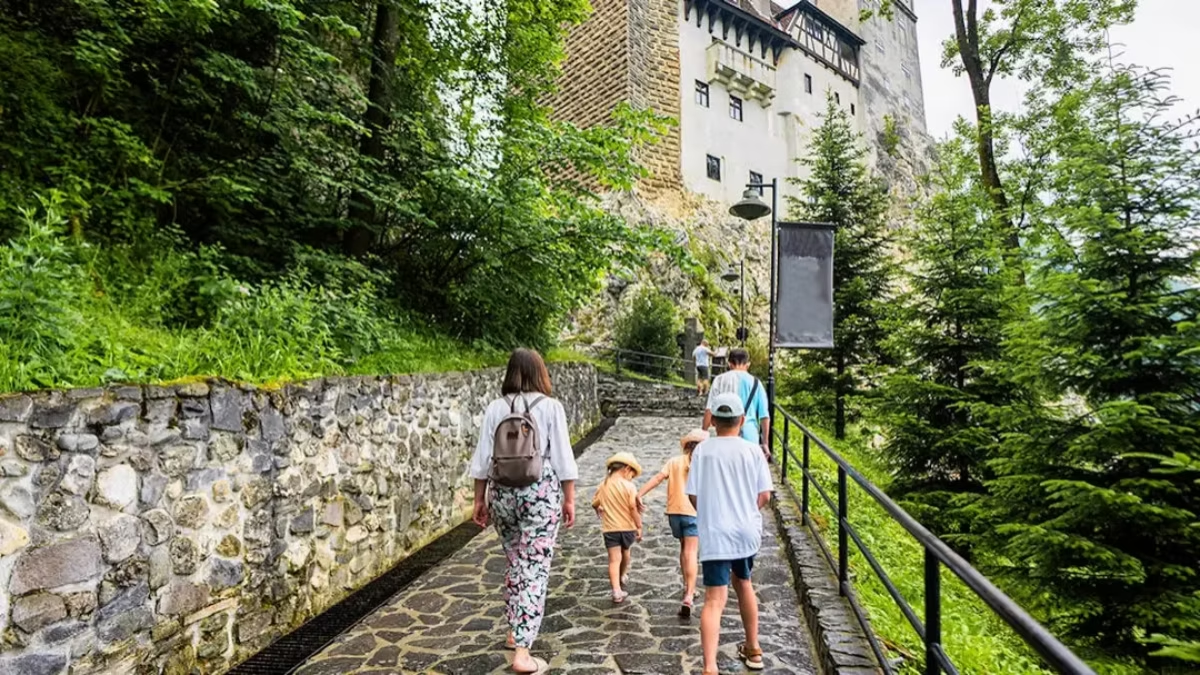
Bran Castle Accessibility Guide
What to Expect for Mobility-Limited Visitors
Bran Castle is not wheelchair accessible inside due to steep staircases, narrow corridors, and uneven floors — a constraint of its Class A historical monument status. However, disabled visitors receive free entry, staff provide personalised support, and a dedicated lift accesses the inner courtyard. The exterior grounds and Royal Gardens are partially accessible. Visitors with reduced mobility can still enjoy a meaningful visit with the right preparation.
Bran Castle is one of Romania’s most visited historic sites — and one that presents genuine accessibility challenges. Built into a rocky hillside in the 14th century, its 57 rooms are connected by steep staircases, narrow stone passages, and uneven wooden floors. No amount of restoration can change these fundamental structural realities, and the castle’s Class A historical monument designation prevents significant modifications.
This guide is written to be completely honest about what is and is not accessible at Bran Castle, so that visitors with mobility limitations, wheelchair users, and those with other physical needs can make well-informed decisions before they visit — and make the most of what the castle does offer.
Wheelchair Accessibility: The Honest Picture
The interior of Bran Castle is not wheelchair accessible. There are no ramps, no internal lifts, and no alternative routes around the steep staircases and narrow corridors that connect its four floors. This is a permanent structural constraint of a Class A listed monument built in the 14th century. Wheelchair users can access the castle grounds, the outer approach path, and the inner courtyard via a dedicated lift.
The castle interior cannot be accessed by wheelchair. This is not a matter of inadequate facilities that might be improved — it is a structural reality of a medieval hilltop fortress that has been protected as a Class A historical monument. Installing ramps between floors or widening its staircases would destroy the historic fabric of the building, and the castle’s administrators cannot authorise such modifications.
What this means in practice: a wheelchair user visiting Bran Castle will not be able to see the Great Hall, Queen Marie’s Apartments, the Secret Passage, King Ferdinand’s Suite, or the upper terraces. The castle’s interior rooms are inaccessible from a wheelchair.
This is an important limitation to understand before making the journey. If seeing the interior rooms is the primary goal of the visit, and if full wheelchair access is required, Bran Castle will not be able to fulfil that goal. Planning a visit around what is accessible — and there is genuinely good content available — will make for a far better experience than arriving with different expectations.
What IS Accessible
The Outer Approach and Entrance Area
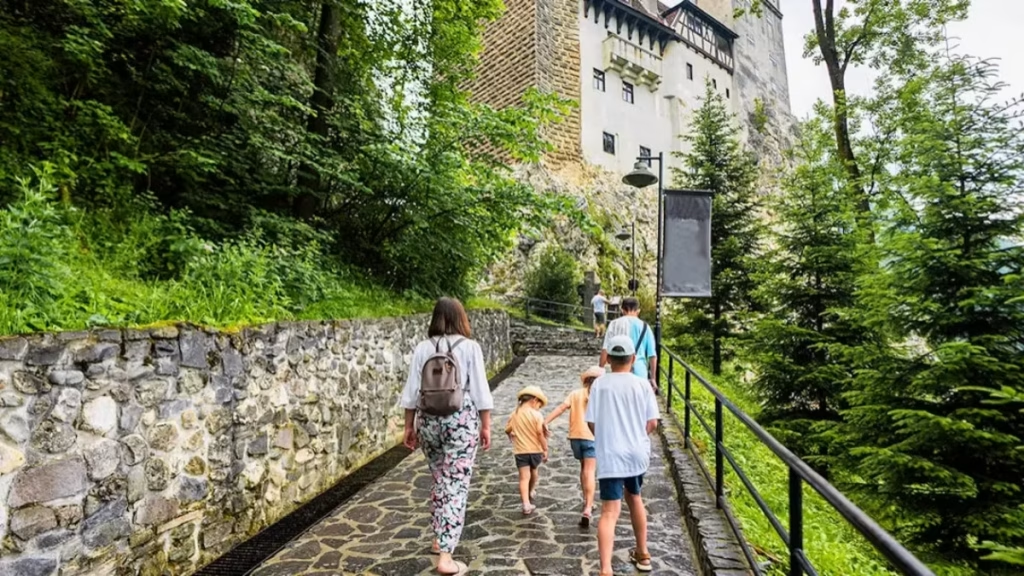
The path leading up to the castle entrance from the parking area and souvenir market is walkable for most visitors with mild to moderate mobility limitations, though it involves an uphill slope. Visitors using wheelchairs will need assistance from companions or castle staff on this approach, as the surface is uneven in sections.
The entrance area includes the ticket office, the main gate, and the beginning of the castle grounds. This area is relatively flat and accessible.
The Inner Courtyard — Via the Dedicated Lift
This is the most important accessibility provision at Bran Castle. A dedicated lift — separate from the Time Tunnel elevator — carries visitors from the entrance level to the inner courtyard, which sits at the heart of the castle. The inner courtyard is one of the most beautiful and atmospheric spaces in the building: the whitewashed walls, red-tiled roofs, and wooden balconies overhead give a powerful sense of the castle’s medieval character.
Castle staff will provide full support to help visitors using wheelchairs or with significant mobility limitations reach the courtyard via this lift. Contact the castle in advance or speak to staff at the ticket office on arrival to arrange assistance.
The Royal Gardens
The Royal Gardens below the castle — the English-style park designed by Queen Marie — are partially accessible. The gardens feature gravel and grass paths rather than paved surfaces, which can be challenging for wheelchairs without firm tyres or electric assistance. The gardens are open and provide good exterior views of the castle, as well as the memorial chapel containing Queen Marie’s heart.
The Souvenir Market and Village
The souvenir market that lines the approach path to the castle is accessible on foot or by wheelchair, though surfaces vary. The village of Bran below the castle has several restaurants and cafés that are accessible or partially accessible.
Staff Support
The Bran Castle team specifically acknowledges that the castle’s physical constraints are significant for visitors with reduced mobility, and commits to providing personalised assistance. From the official castle website: castle staff will provide all necessary support to navigate the alley and to use the lift that accesses the inner courtyard.
In practice, this means: if you arrive with mobility limitations and need help navigating the approach or reaching the courtyard, speak to a member of staff at the ticket desk. They will guide you to the accessible lift and provide any additional support that is within their ability to offer.
It is worth calling or emailing the castle in advance of your visit — particularly if you have specific requirements — so that arrangements can be made before you arrive. The castle’s contact details are available on the official website at bran-castle.com.
Free Entry for Disabled Visitors
Bran Castle offers free entry to visitors with disabilities, regardless of nationality, upon presentation of appropriate documentation (a disability certificate or equivalent official document). This applies to the standard castle entry and to the inner courtyard access via the dedicated lift.
Note that add-on experiences — the Time Tunnel (30 lei) and the Torture Museum (30 lei) — have their own separate ticketing. Check with the ticket desk on arrival for the current policy on these add-ons for disabled visitors.
Visitors with Other Physical Needs
Partial Mobility Limitations (Can Manage Some Stairs)
Visitors who can manage stairs with assistance but cannot complete the full four-floor route will still be able to access significant portions of the castle. The ground floor, the first floor (Great Hall and Armory), and the inner courtyard are the most accessible sections. Using the inner courtyard lift avoids the steepest external approach.
Handrails are present on most staircases inside the castle, though their height and placement reflect the building’s historic character rather than modern accessibility standards. Sturdy footwear with good grip is strongly recommended.
Visual Impairments
The castle does not currently offer audio guides, Braille interpretation panels, or dedicated tactile experiences for visitors with visual impairments. Multilingual text panels are available throughout, and the castle staff can provide verbal orientation support. Visitors with visual impairments visiting with sighted companions will benefit from the standard interpretation panels, which companions can read aloud.
Hearing Impairments
The standard self-guided visit relies primarily on written interpretation panels, which are fully accessible to visitors with hearing impairments. Guided tours are verbal and would need to be supplemented with written notes or a companion interpreter for visitors with significant hearing loss.
Cognitive Accessibility
The castle’s self-guided format, with a clear one-way route and interpretation panels at each room, is generally suitable for visitors with cognitive accessibility needs. The visit can be shortened at any point by following exit signage — visitors are not obligated to complete the entire route.
Practical Tips for Visiting with Mobility Limitations
- Contact the castle in advance: Call or email to discuss your specific requirements and arrange lift access to the courtyard
- Bring documentation: A disability certificate or equivalent is required for free entry
- Visit on a weekday morning: Crowds are thinnest early on weekdays, which makes navigating the accessible areas more comfortable
- Wear sturdy footwear: Even accessible areas involve uneven surfaces; closed-toe shoes with good grip are essential
- Bring a companion: The castle staff are supportive, but a companion provides practical assistance on approach paths and uneven surfaces
- Allow extra time: Accessible navigation takes longer; plan for a relaxed visit without a tight schedule
- Plan meals nearby: The village of Bran has restaurants accessible by road; the castle grounds have limited accessible dining
The Time Tunnel: Partial Accessibility
The Time Tunnel — the underground multimedia experience accessed via a glass elevator in the castle’s inner courtyard — is the one interior experience that may be partially accessible to wheelchair users. The glass elevator itself is designed for vertical access, and the tunnel pathway below is relatively level. However, full wheelchair accessibility of the Time Tunnel is not guaranteed, and visitors with mobility limitations should confirm current conditions with castle staff on arrival.
The Time Tunnel costs 30 lei as a standalone add-on and is included in the Royal Tour combo ticket.
Frequently Asked Questions
Is Bran Castle wheelchair accessible?
The castle interior is not wheelchair accessible due to steep staircases, narrow corridors, and uneven floors. The inner courtyard is accessible via a dedicated lift, and castle staff provide support. Disabled visitors receive free entry.
Do disabled visitors get free entry to Bran Castle?
Yes. Bran Castle offers free entry to visitors with disabilities of any nationality upon presentation of appropriate documentation. The free entry applies to the standard castle and courtyard access.
What can wheelchair users see at Bran Castle?
Wheelchair users can access the castle grounds, the approach path (with assistance), the inner courtyard (via a dedicated lift with staff support), and the Royal Gardens below the castle. The interior rooms, including the Great Hall, royal apartments, and secret passage, are not accessible by wheelchair.
Can I request accessibility assistance in advance?
Yes — and it is recommended. Contact Bran Castle directly via the official website (bran-castle.com) before your visit to discuss your requirements and ensure that lift access and staff support are arranged in advance.
Are there accessible toilets at Bran Castle?
Toilets are located near the main entrance area. Check current accessible toilet availability with castle staff on arrival, as facilities may vary.
