
Queen Marie’s Apartments at Bran Castle
A Guide to the Royal Rooms
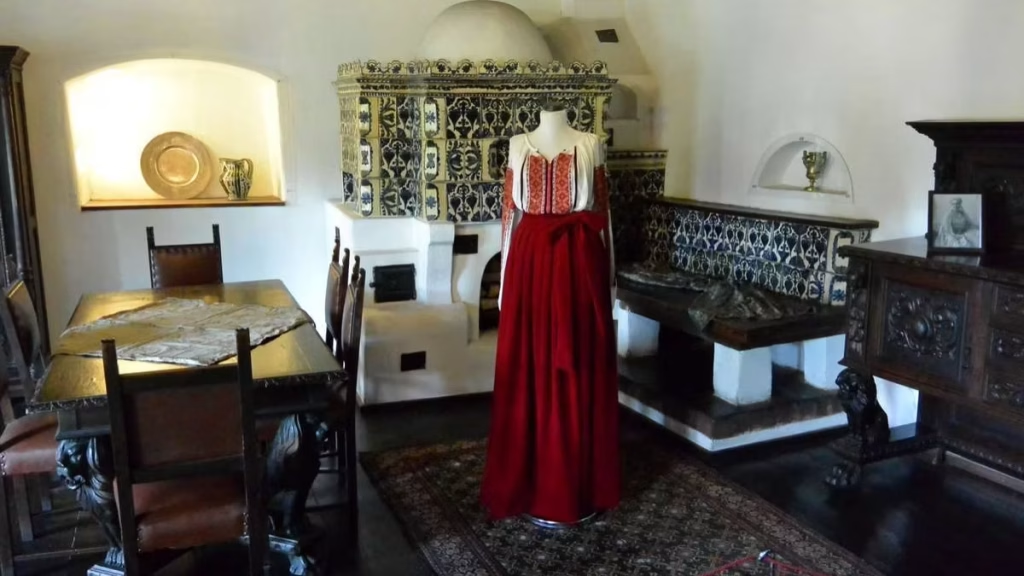
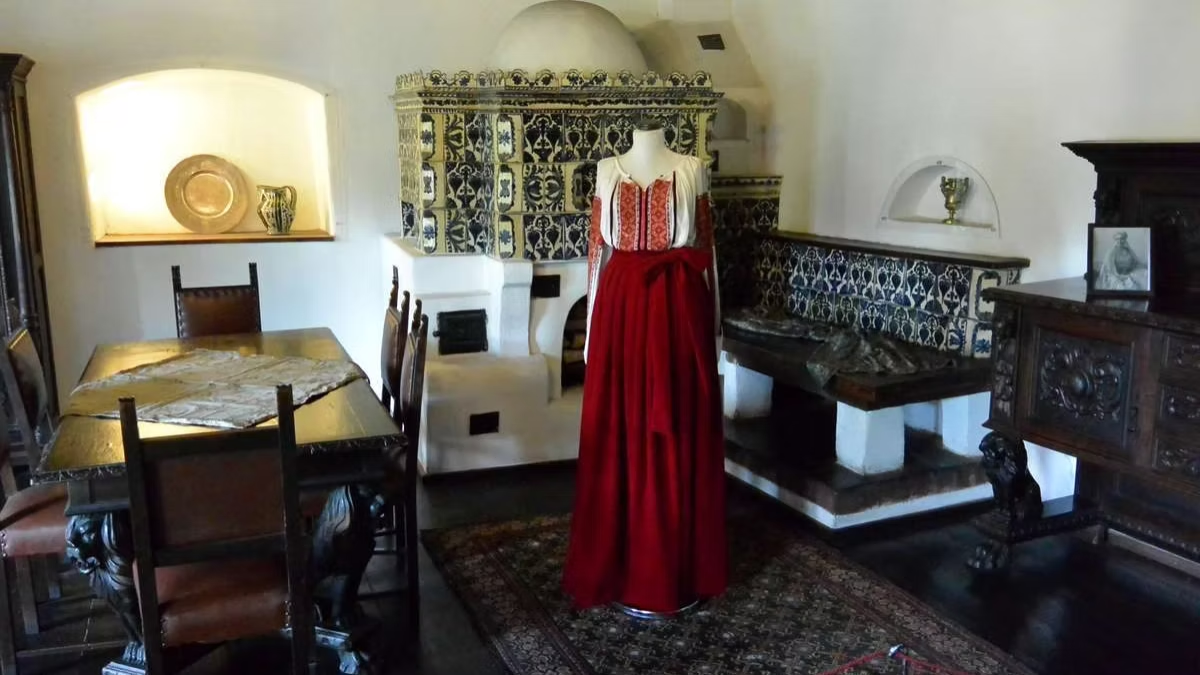
Queen Marie’s apartments at Bran Castle occupy the second floor and include her bedroom, two private salons, a dressing room, a dining area, and a bathroom. The rooms are furnished with original royal pieces and reflect the queen’s personal artistic taste. They are part of the standard self-guided visitor route and are considered the most historically significant rooms in the castle.
Of all the spaces inside Bran Castle’s 57 rooms, none speak more powerfully to the castle’s true history than the royal apartments of Queen Marie. The Dracula legend may draw the crowds, but it is the story of this remarkable woman — one of the most influential and beloved figures in Romanian history — that gives Bran Castle its greatest depth and emotional resonance.
Queen Marie received Bran Castle as a gift from the citizens of Brașov in 1920. She found a ruined medieval fortress and transformed it, over the course of nearly two decades, into one of the most elegantly personal royal residences in Eastern Europe. Her apartments on the second floor remain the most richly furnished and most thoroughly royal spaces in the building — a window into the life and sensibility of a woman who shaped modern Romania as much as any politician of her era.
Who Was Queen Marie of Romania?
Born Princess Marie of Edinburgh in 1875, Queen Marie was the granddaughter of both Queen Victoria of Britain and Tsar Alexander II of Russia. She married Crown Prince Ferdinand of Romania in 1893 and eventually became queen consort when Ferdinand ascended to the throne in 1914.
During World War I, Marie played a decisive role in Romania’s diplomatic fate. Her personal lobbying of the Allied leaders at the Paris Peace Conference in 1919 is widely credited with securing Transylvania, Bessarabia, and Bukovina for Romania through the Treaty of Trianon — effectively doubling the country’s territory. She is remembered in Romania as a national hero.
A talented artist, writer, and interior designer, Marie brought a distinctly personal and aesthetic vision to every space she occupied. Bran Castle was her favorite residence, and her imprint on it is visible in every room she touched.
Queen Marie’s Apartments: Room by Room
The Bedroom
Queen Marie’s bedroom is perhaps the most intimate room in the castle. It is furnished with the queen’s original bed, hand-embroidered linens, and personal items that give the room the feeling of a space still recently occupied. The decoration blends Western European elegance with Romanian folk motifs — a signature aesthetic of Marie’s, who was deeply interested in preserving and elevating Romanian traditional craft.
The windows of the bedroom overlook the courtyard below, and the quality of the light that enters the room in the morning hours was reportedly one of the features Marie particularly valued. She was known to write in her bedroom early in the morning — she was a prolific author, publishing memoirs, travel writing, and children’s stories throughout her life.
The Two Salons
Queen Marie’s two private salons are the most visually spectacular rooms in the apartments. The larger of the two was used for receiving guests and hosting smaller informal gatherings; the second served as a more private sitting room. Both are decorated with an extraordinary density of objects: paintings, ceramics, embroidered cushions, carved furniture, and personal photographs.
Marie was a collector as well as a creator, and the salons reflect both qualities. The furniture includes pieces from across Europe and from Romania’s own craftsmen, combined with a confidence and specificity that speaks to her genuine eye for design. The rooms do not feel like a museum reconstruction — they feel like the rooms of someone who cared deeply about how they looked.
The Music Room
Adjacent to the salons, the music room reflects another dimension of Marie’s artistic life. The queen was an accomplished musician and the room was a functional space, not merely decorative. Its ornate furnishings and beautiful views of the village below made it one of the most sought-after rooms in the castle for informal gatherings.
The Dining Area
Queen Marie’s dining area within her private apartments was used for intimate family meals rather than formal state dinners, which would have taken place in the Great Hall below. The room is furnished with a modest but beautifully made dining table and chairs, with tableware that reflects the queen’s interest in Romanian decorative arts.
The Dressing Room and Bathroom
The dressing room and bathroom are evidence of the modernization Marie undertook at Bran. She installed hydroelectric power in the castle, updated its plumbing, and fitted the apartments with amenities that were genuinely advanced for a 750-meter mountain fortress in 1920s Romania. The dressing room retains some of the original fittings from this era.
Queen Marie’s Artistic Vision at Bran Castle
Marie’s approach to Bran Castle was not that of a restorer trying to return the building to a historic original state. It was that of an artist creating a home. She collaborated with Czech architect Karel Liman on the structural and architectural changes, but the interior decoration was almost entirely her own work.
She brought Romanian folk art into dialogue with European royal aesthetics, commissioning local craftsmen to make furniture and textiles that sat comfortably alongside pieces she brought from her travels. The result is a visual language unique to Bran Castle — one that belongs to neither the medieval fortress nor the standard European royal palace, but occupies a distinctive middle ground between the two.
Queen Marie also redesigned the castle’s gardens and grounds extensively, adding the English Park with its two ponds and tea house, a guesthouse, a wooden church, staff housing, stables, and a garage. Many of these structures are still visible in the Royal Park below the castle today.
Queen Marie’s Heart at Bran Castle
Perhaps the most extraordinary detail of Queen Marie’s connection to Bran Castle is that her heart is buried here. When the queen died in 1938, her body was interred at the royal mausoleum at Curtea de Argeș — but at her own request, her heart was removed and placed in a golden casket, which was buried in a chapel at Bran Castle.
After World War II, when the communist regime expelled Princess Ileana from the country, the golden casket was moved and eventually lost. It was found decades later in the National History Museum of Romania. The heart was finally returned to Bran in 2015 and now rests in a small memorial chapel on the southwest side of the castle, across a small brook at the edge of the woodland. Visitors can see it from the grounds.
The Legacy of Queen Marie at Bran Castle
Marie died in 1938. Her youngest daughter, Princess Ileana, inherited the castle but was forced out of Romania by the communist regime in 1948. The communists opened the castle as a museum in 1956. After the fall of communism, the Romanian government eventually returned the castle to Princess Ileana’s son, Archduke Dominic of Habsburg, in 2009 — making Bran Castle Romania’s first privately owned museum.
The Dominic Collection, displayed on the second floor alongside Queen Marie’s apartments, reflects this Habsburg inheritance. The fine glassware and decorative objects in the collection were gathered across generations of one of Europe’s oldest royal families, and their presence in these rooms reminds visitors that Bran Castle’s royal story did not end with Marie.
Visitor Tips for the Royal Apartments
- The apartments are on the second floor — follow the one-way route from the first floor
- Morning visits offer the best light in the bedroom and salons, which face east and south
- Allow extra time on this floor — it rewards a slow pace and close attention to detail
- Photography is permitted without flash
- Interpretation panels in each room provide historical context in multiple languages
Frequently Asked Questions
Are Queen Marie’s apartments original?
Yes. The furniture, textiles, ceramics, and personal objects in the royal apartments are largely original to Queen Marie’s residency. The rooms have been maintained as a museum since 1956, with careful attention to preservation.
Can I see Queen Marie’s heart during a visit to Bran Castle?
The memorial chapel containing Queen Marie’s heart is located on the grounds below the castle, on the southwest side near the edge of the woodland. It is accessible on foot from the castle exit and can be visited after the main castle tour.
Where are the royal apartments in Bran Castle?
Queen Marie’s apartments are on the second floor of the castle, forming the central section of the self-guided visitor route. You access them via the main staircase from the first floor or through the secret passage.
